
Is Vibe Coding Bad for Business? What 200 Years of Computing Tells Us


QUICK SUMMARY
Is vibe coding bad? Probably not, but it’s the wrong question. AI changes how software gets built, not what makes it valuable. Someone still has to understand what people need, decide what’s worth building, and answer for the result. That’s what Punchcard has always done, and AI doesn’t change it.


There’s a lot of noise about AI right now, and it might make you think you don’t need people like us anymore. Why not just build it yourself? What’s an agency like Punchcard for? They’re fair questions, and I want to answer them. But to get there, I want to talk about what software is and how we got here.
All software is lightning and silicon. We take sand, refine it into silicon, and etch it into chips. Then we harness lightning, call it electricity, and push it through those chips, which work like billions of tiny switches flipping on and off. Everything we call software comes down to instructions for where that lightning goes.
Those instructions have come a long way. The first programmers set switches by hand and wrote raw numbers. Then came programming languages that look almost like English, then ready-made building blocks. Each layer is built on top of the one before it, so you can stop thinking about the layer below.
Every new layer has made building easier and opened the door to more people. Spreadsheets let accountants build their own financial models. Website builders let small businesses skip hiring a developer. No-code tools let operations teams wire up their own workflows.
Now, with AI, you can build using the language you learned before you could read. Describe what you want, accept what comes back, and keep going. That’s what people mean by vibe coding.
It makes writing code easier than it has ever been. But writing code was never really the point.
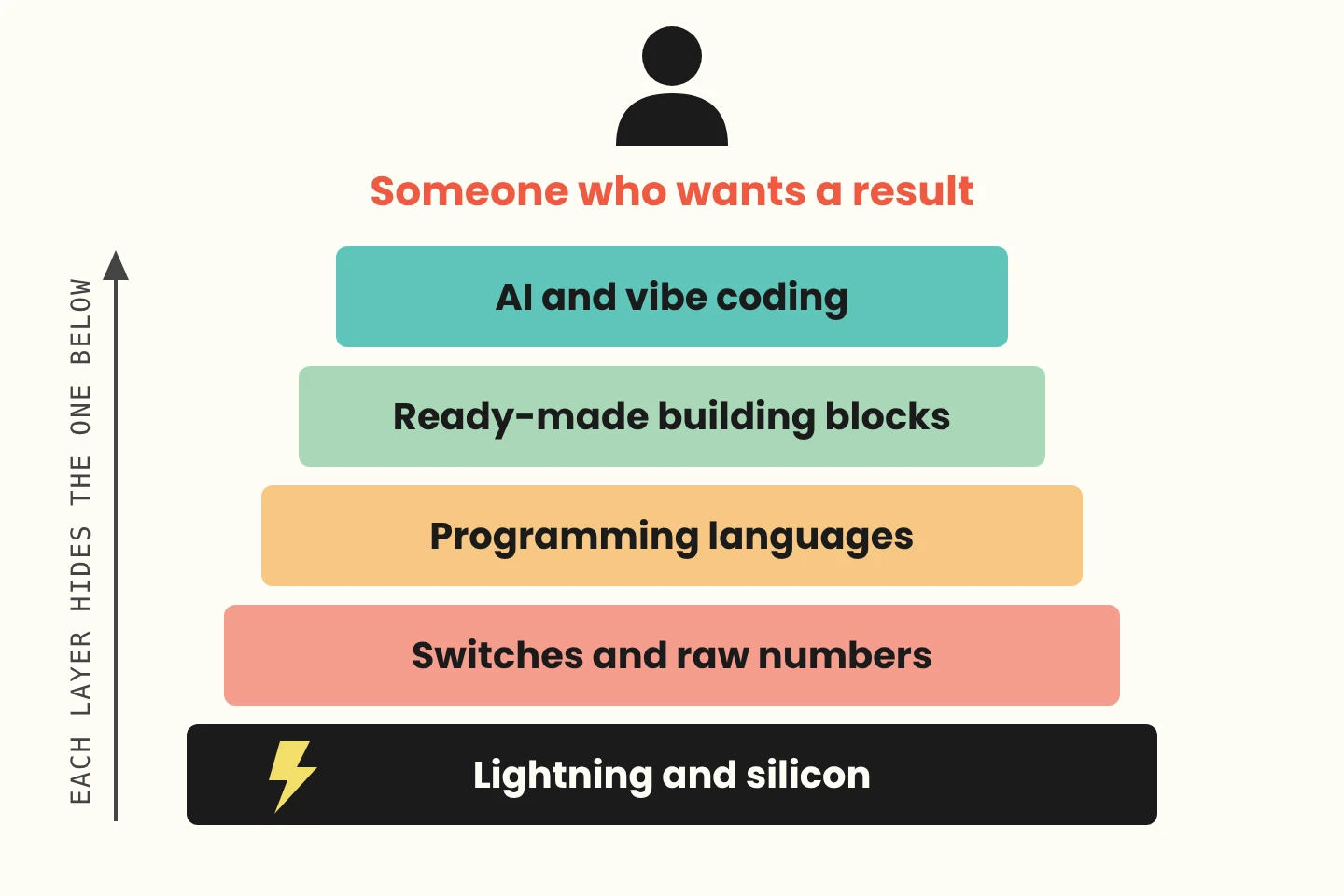
With every new layer, people have wondered whether they’d ever need to hire a developer again. That pattern is older than computers. Let’s look back at a few other times the tools changed, and see what actually happened.
What 200 years of computing tells us
We think of lightning and silicon as the bottom, but it hasn’t always been. Silicon has only been the bottom since the 1950s, and every time the bottom was swapped out, the work on top carried on.
Keep going back and you reach 1890, and the reason we’re called Punchcard. For that year’s United States census, the Census Office used Herman Hollerith’s new machines, which used electrical contacts to read holes punched in cards. Lightning, but no silicon.
The 1880 census had taken about seven years to tabulate by hand. In 1890, with more people to count than ever, they had a rough count in just six weeks. That’s the kind of jump people are promising from AI today, and it happened 136 years ago.
And it was still a census. The punched cards weren’t the point. The counting got dramatically faster, but somebody still had to decide which questions to ask and what the answers meant. We named our company after a productivity revolution that delivered the same value in a fraction of the time.
Go back another fifty-odd years and the lightning disappears too. In 1834, Charles Babbage began designing the Analytical Engine, a programmable computer built from gears instead of circuits. It was never finished, but Ada Lovelace still wrote what’s often called the first computer program for it.
She summed up the machine in one line. “It can do whatever we know how to order it to perform.” No electricity and no silicon, just instructions. Nearly two hundred years ago, the hard part was already knowing what those instructions should be.
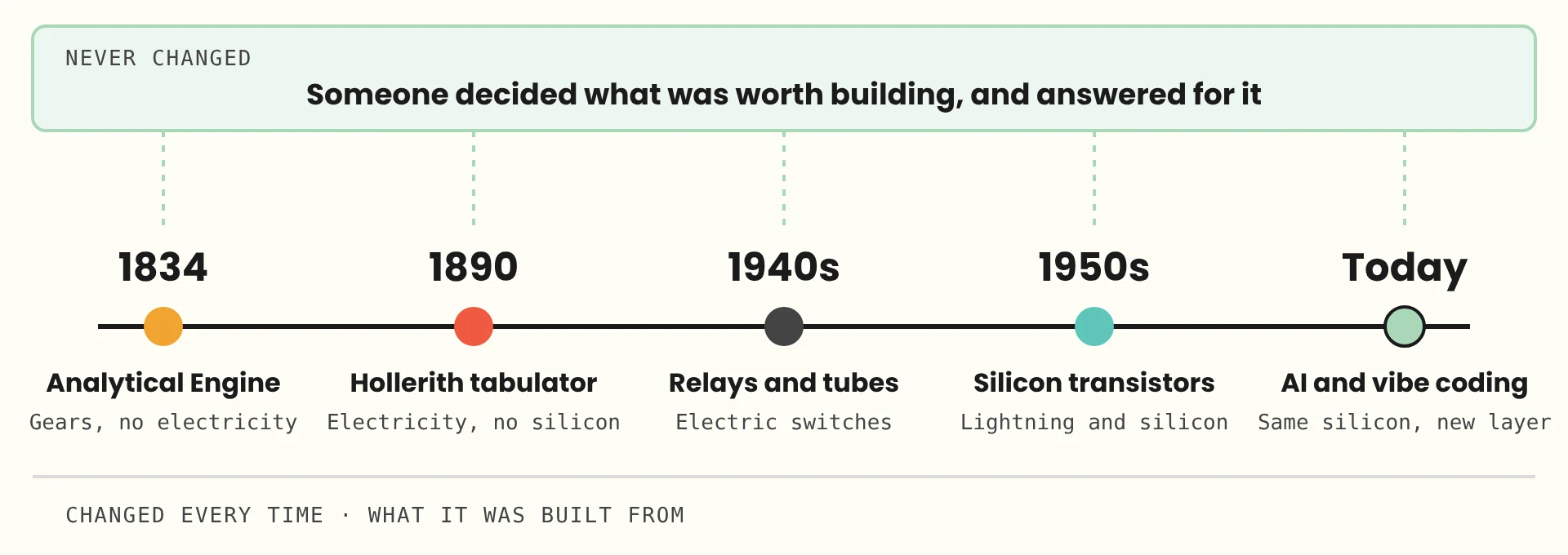
What’s at the bottom keeps changing, and it has never changed what matters. That has always been at the top.
Vibe coding vs traditional coding
What’s at the top? Above every layer, there’s always a person who wants something. The Census Office wanted to know who lived in the country. Today, a business wants software its customers or employees will actually use.
Traditional coding and vibe coding are just the two newest layers in that line. Line everything up from Babbage to now, and here’s what changed and what didn’t.
| What changed | What didn’t |
|---|---|
| How much it costs to build | Understanding what people need |
| How fast it gets built | Deciding what’s worth building |
| Who gets to build it | Answering for the result |
Every new layer changed the first column. AI changes it further and faster than most, and I don’t want to downplay that. But it doesn’t touch the second column. That one has always needed a human in the loop.
Can you build software yourself with AI?
Often, yes. But if the second column always needs a human, building it yourself means you’re that human. It’s worth knowing what you’d be getting yourself into.
The decisions you didn’t make
Every layer makes decisions for you. A website builder decides how your pages load. A no-code tool decides how your data gets stored.
Vibe coding goes further. AI writes the code and decides how your whole application fits together, then shows you the result and leaves it up to you to evaluate.
Code used to be the expensive part, and AI is making it cheap. But the decisions inside it were always the part that mattered. They don’t disappear because you didn’t make them, and you’ve accepted every one.
When it breaks
Most of the time that’s fine. It’s the whole point of the layers. But sooner or later something underneath changes or breaks, and whoever is on top has to deal with it, ready or not.
You know the feeling. There’s a spreadsheet that runs the whole business. One day an update breaks it, and the person who built it retired years ago. Now it’s yours, and you don’t know how it works or how to fix it.
Vibe-coded software has its own version. It works beautifully in the demo, then meets real users, real data, or a security review, and starts to come apart. When that happens, “the AI wrote it” isn’t an answer. Not to your customers, not to your boss, not to your auditors, and not to yourself.
Whoever accepted the work owns it. The typing changed hands. The accountability didn’t.
Build or buy?
We use AI to build software every day, so this isn’t an argument against it. It’s the real build vs buy question. Not whether you can build it yourself, but whether you want to own everything that comes with it.
Is vibe coding the future?
Probably, at least for how code gets written. But coding was never really about the code. The bigger change is what gets built. Ideas that were never worth the cost suddenly are, and ideas nobody had before start to emerge.
A lesson from the early web
That has happened before. When the web was new, nobody needed a search engine. There were few enough sites that you could keep track of the ones you cared about.
Then the web got popular, and it grew faster than anyone could keep up with. Finding things became the problem, and search became something everyone needed. The need didn’t exist until the web was big enough to create it. Babbage wasn’t thinking about searching the internet.
AI will do the same thing. I can’t tell you what we’ll be building in five years, and I don’t think anyone can. I expect a lot of it will be things nobody is asking for today.
More options, more decisions
For you, that means more options than you’ve ever had. Things that were out of reach last year might be worth building now. But with more options, deciding what to do matters even more.
Which of these ideas matters most to the people who’ll use it? Which one is worth building first? Who answers for it when it goes wrong? New possibilities make those questions come up more often, not less.
Vibe coding may well be the future of writing code. What it opens up is a future full of decisions.
Outcomes over outputs
That brings me back to where we started. What’s an agency like Punchcard for?
Not just the software. We’ve been saying “outcomes over outputs” for years. We judge our work by what it does for you, not by how much code we write, and AI just makes that difference easier to see. What we bring is that second column, the part that never changed.
We take the time to understand what people need. We help you decide what’s worth building, in what order, and what isn’t worth building at all. We’ll tell you when something you’re asking for is a bad idea. And when something goes wrong, we answer for it instead of pointing at the AI.
What you get is software that solves the right problem, in the right order, with someone standing behind it.
If you use AI to build something yourself, treat it like any other software your business depends on. Someone needs to own the decisions inside it and be ready when it breaks. That someone will end up being you. Or it can be us.
None of this is new. Code was always a means to an end, never the end itself, and at Punchcard we’ve always built with the end in mind. All that’s different now is that we have new and exciting ways to get there.
All software is lightning and silicon… for now. But that doesn’t matter. What matters has always been the parts that sit on top. That’s what we do.
Frequently asked questions
Is vibe coding bad?
Probably not, but it’s the wrong question. It’s a fast way to build, and we use AI in our own work every day. The better question is who owns the decisions the AI makes, because someone has to answer for the result.
Is vibe coding secure?
It can be, but not by default. AI-generated code can look finished and still have gaps that only show up with real users, real data, or a security review. Treat it like any software your business depends on, with review, testing, and someone accountable for fixing what breaks.
Should I build or buy software?
It depends on how central the software is to your business and who will own it after launch. Off-the-shelf tools work well for common problems, and AI makes building it yourself more tempting than ever. When the software is how you compete or how your team gets work done, buying it from a partner gets you something built around you, with someone accountable for the decisions inside it. Learn more about our custom software development.
What does “outcomes over outputs” mean?
It means we measure our work by the result it creates for you, not by how much code we write. The software is how we get there. It was never the point.

You Might Also Like
Featured Posts

AI 101: How AI Works, Explained for People Who Don’t Work in Tech
Read more: AI 101: How AI Works, Explained for People Who Don’t Work in Tech
AI Guardrails and Access Control: What to Put Around AI Before You Let It Act
Read more: AI Guardrails and Access Control: What to Put Around AI Before You Let It Act
AI Agents vs. Chatbots: What “Agentic” Actually Changes
Read more: AI Agents vs. Chatbots: What “Agentic” Actually Changes


Want to continue following our story?
Sign up for our newsletter to keep up-to-date on the latest news at Punchcard.
"*" indicates required fields